💌 Just a quick note before we get started: this post contains affiliate links. That simply means I might earn a small commission (at no extra cost to you) if you decide to book or buy through one of the links. It helps me keep Postcards from Kirsty running — and hopefully helps you plan your own adventure too!
There are more than 30 places in 11 countries named Aberdeen, from the United States to Hong Kong to South Africa. The name has gone the distance. For this blog post, I am going to be focusing on Aberdeen in Scotland.
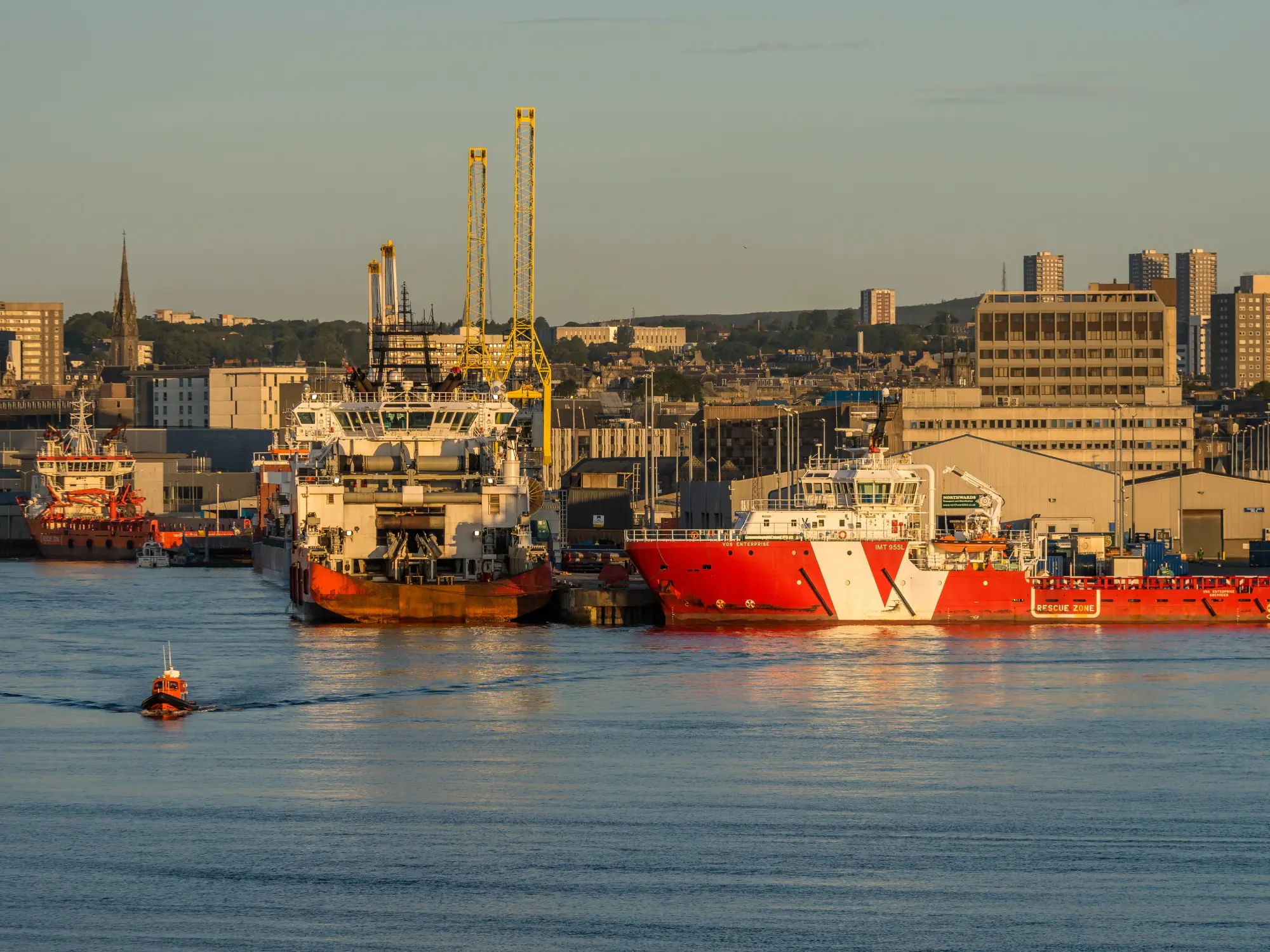
You’ll find the city of Aberdeen on the north-east coast of Scotland. The name ‘Aberdeen” translates to the mouth of the River Don. It’s the 3rd largest city in Scotland, with a population of over 200,000 and has been famously dubbed ‘the grey city’. This is due to the locally sourced granite stone that was used for a lot of the buildings. Then, you add in the typical Scottish grey weather, and you can start to understand how they got to that name. It’s worth noting that Aberdeen actually originated as two separate burghs that didn’t unite until 1891, when Aberdeen was officially granted city status. These two separate burghs are Old Aberdeen, which consists of the University and the Cathedral and New Aberdeen, which is a trading and fishing settlement.
A little bit of the history about Aberdeen… It’s thought that Aberdeen was founded in the 8th century AD as a fishing settlement, although there has been human presence in this area since the Stone Age! In the 12th century, Aberdeen established itself as a town with a population of 3,000. However, it was hit by some turbulent times including being burned by an English Army in 1336, the black death (a.k.a the plague) hit the town in 1350 and wiped out 50% off the population (and it had another outbreak of this in 1647) and in 1401, another disease known as the ‘pest’ hit the town and it suffered a severe outbreak of this same disease in 1536. However, this didn’t stop the town from growing, and by the early 17th century, Aberdeen had a population of 8,000-10,000, which was quite significant at this time. During the 18th century, Aberdeen became more civilised and comfortable (for the rich anyway!). However, the fate of Aberdeen really changed with the discovery of oil in the North Sea in the 1970s, and it quickly became the main industry in the city. This led to a lot of growth and prosperity in the city.
Aberdeen is a city with a rich history. To really get a true sense of what the city has to offer, I’d suggest 2-3 days here.
Top 10 Things to Do in Aberdeen
Marischal College
Marischal College has one of the most impressive buildings in Aberdeen. Marischal College was founded in 1596 and was Aberdeen’s second oldest university, second only to King’s College, which was founded in 1495. This particular building in the picture below, however, wasn’t completed until 1906. It’s made largely of granite, sometimes being referred to as “the icon of the granite city”, and is located just off Aberdeen’s main street, Union Street, in the city centre. Since 2011, it has had a different purpose; it’s used as the headquarters of Aberdeen City Council.
You can’t visit inside Marischal College, but it’s impressive enough to see it from the outside. Take a wander down Union Street to do a bit more city centre sightseeing, and if you’re looking for some good bars/restaurants, then go to Belmont Street, located just off Union Street.
Provost Skene’s House
This museum celebrates the life and achievements of 100 pioneering individuals who were born, lived or worked in Aberdeen and the North-East and who not only shaped the life of the city, but the world.
It is the oldest surviving townhouse in Aberdeen, dating back to 1545. The building is named after one of its owners, Sir George Skene. He was a wealthy merchant and provost of Aberdeen (1676-1685). The building was threatened with demolition in 1940, but a public campaign saved it, and in 1953, it became a museum. Since 2019, it has gone through a major refurbishment and reopened in October 2021.
It takes about 2 hours to visit. It’s open 7 days a week (Monday-Saturday 10am-5pm and Sunday 11am-4pm), 365 days a year and is free to visit! Also, no advance booking is required.
Aberdeen Art Gallery
Aberdeen Art Gallery contains some of the UK’s finest art collections in one of the city’s most impressive granite buildings. There’s work featured by Scottish artists, makers and designers spanning over 700 years. The art gallery has been amassing its collection of art since it opened in 1885. Between 2015 and 2019, it underwent another transformation, which allowed the museum to display more art collections, it had extensive work on the Cowdray Hall concert venue and the Remembrance Hall, and it also vastly improved the visitor facilities.
It takes about 2-3 hours to visit. It’s open 7 days a week (Monday-Saturday 10am-5pm and Sunday 11am-4pm), 365 days a year and is free to visit! Also, no advance booking is required. It’s also got a cafe on the ground floor and level 2.
Codonas and Aberdeen Beach
Cordona’s is an amusement park, located right next to Aberdeen beach. It was established by the Cordona family in the 1970s. If you’re looking for a fun day out, then this is it. Cordona’s amusement park has everything from bowling to indoor and outdoor golf, laser tag, go-karting, indoor and outdoor play areas and thrill rides.
Cordona’s and Aberdeen beach are located just a 20-minute walk from the city centre. Aberdeen beach is a lovely place to go for a walk along the seafront and blow the cobwebs away.
Duthie Park
Duthie Park was donated to Aberdeen city by ‘Miss Duthie’ in 1880 and opened to the public shortly after in 1883. The gardens are the third most visited gardens in Scotland. There are lots of lovely walks and things to see around the park, including the bandstand, fountains, ponds and statues. There’s also the David Welsh Gardens located in the park, which is one of Europe’s largest indoor gardens and is home to the world’s only talking cactus!
It’s located about a 25-minute walk from Aberdeen city centre. The park is open 24/7 and is free to visit. The David Welsh Gardens are also open 7 days a week, but only at specific times during the day, usually 10.30 am-4/5 pm, but Google it just to be sure.
Footdee (or “Fittie” in Scots)
Footdee is an old, quaint fishing village located near Aberdeen Harbour. It’s a 20-25 minute walk from Aberdeen city centre. It dates back to the early 19th century and is one of the hidden gems in the city. The community was designed by the Architect John Smith (who also designed Balmoral Castle) in order to re-home the local fishermen, who were living in poor conditions around the harbour. It’s now a conservation area with around 80 sought-after homes. Fun fact: the cottages all face inward with their backs to the sea to protect them from the harsh weather and storms.
Take a wander through the narrow cobbled streets, and you’ll find cottages with so much character. It’s a colourful, quirky and charming area of the city!
Maritime Museum
To understand a bit more about the history and life of the city, the maritime museum is a must-see. Aberdeen has always had a very close relationship with the sea since it began as a small town. The award-winning maritime museum tells the story of fishing, fast sailing ships, shipbuilding and port history. It’s also the only place in the UK where you can see displays of North Sea oil and the gas industry. The museum is located close to Union Street and the harbour on the historic Shiprow and is free to visit when it is open.
St Machar’s Cathedral
St Machar’s Cathedral is located to the North of Aberdeen city centre in the former burgh of Old Aberdeen. The cathedral dates back to the 12th century. Very little of the original structure exists after it was demolished in the 14th century, and it wasn’t fully rebuilt until the 16th century. It’s about a 40-45 minute walk from the city centre. However, there are buses (numbers 1/2/20, 17A, 19 or 68/291/X63) that run out to the cathedral and take around 25 minutes.
After William Wallace’s execution in 1305, his body was cut up and sent to different parts of the country. Legend has it that his left arm apparently ended up here and is buried in the walls of the cathedral. The cathedral is still used as a place of worship to this day.
Brig O’Balgownie
Brig O’Balgownie is Scotland’s oldest bridge, dating back to the late 13th or early 14th century. The bridge is said to have been started by Bishop Henry Cheyne and completed by Robert the Bruce. Back in the day, this was the main bridge connecting Aberdeen to the north over the River Don and was an important trade route. The bridge was mentioned in Lord Byron’s famous poem, ‘Don Juan’. The bridge was rebuilt in the early 17th century into the one we see today.
The bridge is located in the former burgh of Old Aberdeen near the University of Aberdeen. It’s about an hour’s walk from the city centre or a 30-minute bus journey (numbers 1/2/20, 50, 53, X60 or X68).
Gordon Highlanders Museum
The Gordon Highlanders Museum is a 5-star ‘Visit Scotland’ attraction, which tells the 200 year history of the soldiers from the Gordon Highlanders Regiment. It covers the Napoleonic wars through both world wars and the Cold War until all Scottish regiments were combined in 2005. Sir Winston Churchill himself described the Golden Highlanders as “the world’s finest regiment”. The museum has interactive exhibits, original film footage and interesting displays to keep you entertained.
It’s open Tuesday to Saturday, 10am-4.30pm (last entry for tours at 3pm). The museum is located to the west of Aberdeen city centre, about a 40-minute walk from Union Street or 15-minutes by bus (numbers 4, 5, 6 or 11). There’s free parking on site and a cafe. Its £10 for an adult ticket and £5 for a child ticket to visit the museum.
Loved this guide to things to do in Aberdeen? Save it to Pinterest for your visit there!
I’d love it if you could drop a comment below, share my Pinterest pins, and subscribe to my blog to stay updated with new posts. Every bit of engagement helps my little travel blog grow!
This post is all about things to do in Aberdeen.
Thanks so much for reading – it means the world!
Kirsty x